The best way to train your dog (it's not what you think)
When a puppy is on the way, we all ask the same question: how am I going to train them? How do I raise a happy dog who doesn't get into too much trouble, listens, and doesn't eat anyone?
So we look for the best guide, the best method. And we often make the same mistake: a patchwork of the best tips picked up here and there. It's human, but it isn't necessarily a good idea when it comes to training a dog.
I'm not a dog trainer. This is simply what my wife and I chose to do, and why.
Choose one method and stick to it
At first, we usually latch onto a book, a YouTuber, an online course or a local trainer. We think: "This is the person I'm going to trust with my dog's training."
For us, it was Tony from Esprit Dog, a French dog trainer. We liked the way he talks about animals and his core principles. Since he offers one course for puppies and another for adult dogs, we decided not to overthink it. We'd follow what he says and apply it, even when we didn't fully understand or weren't convinced. His method objectively works for lots of other dogs, so there's no reason it shouldn't work for Jaina.
When it doesn't work, the urge to switch methods
In reality, with a puppy, not everything works all the time. And as humans, we tend to assume the technique is the problem. That the trainer is talking nonsense.
Example: you ask your dog to sit, applying the course technique exactly. And they don't sit. With a video course, nobody is watching you to say: "Careful, you're not doing what the video shows at all." So you think: "I'm doing everything perfectly, and she won't sit." And you go looking for someone else's explanation of how to teach sit.
Maybe it'll work. This article isn't saying only one technique works. But if you keep picking bits from here and there, there will inevitably be gaps in your dog's overall training.
Training is a whole
Tony often says it: training a dog is a whole. If your dog doesn't listen, there could be a thousand reasons:
- they're not getting enough activity;
- they're somewhere unfamiliar;
- you're stressed;
- and often, it's our own amateur mistakes, which we can't see because we lack perspective.
You can't move one area forward and leave the rest behind. For example, you can't have perfect obedience at home with a dog who has never been to town: in town, the training won't hold up.
A trainer with a complete approach doesn't just give you one tip. They help you raise a balanced, happy dog in every area. Every piece of advice has a reason, and the whole thing balances out. If you take one small part from them and another from someone else, each method's weak spots plus your own approximations can mean nothing works.
Beware the TikTok patchwork
I'm not saying you should stick with a trainer forever if you're getting no results. Every dog is different, every situation too, and we all have flaws that show up in how we train our dogs. That's why an outside eye is sometimes needed.
But be wary, especially on social media, of the reflex: "So-and-so uses this technique, I'll use it." Then you come across another TikTok, another technique, and you adopt that too. And you end up with a patchwork that has no rhyme or reason, no internal logic, and doesn't cover all your dog's needs. Since you switch techniques whenever something doesn't work right away, you end up forgetting what you even did. (On social media pressure, I've also written an article on the comparison trap.)
How we did it
My wife and I decided our absolute reference would be Tony. That's obviously not a universal truth, but it was our rule. Whenever we hesitated, we went back to the video: "What did he say? OK, we'll do that."
And it's easier as a pair. One of us would say: "You know, I think we're doing that bit wrong." Or: "Did you notice that little detail? We're not doing it. That's why it isn't working." So we kept going, rather than deciding after a week that our dog should already be perfect, that the trainer was talking rubbish, and that we'd cook up our own approach, which might work… or be an even bigger disaster.
Where Quest.Dog fits in
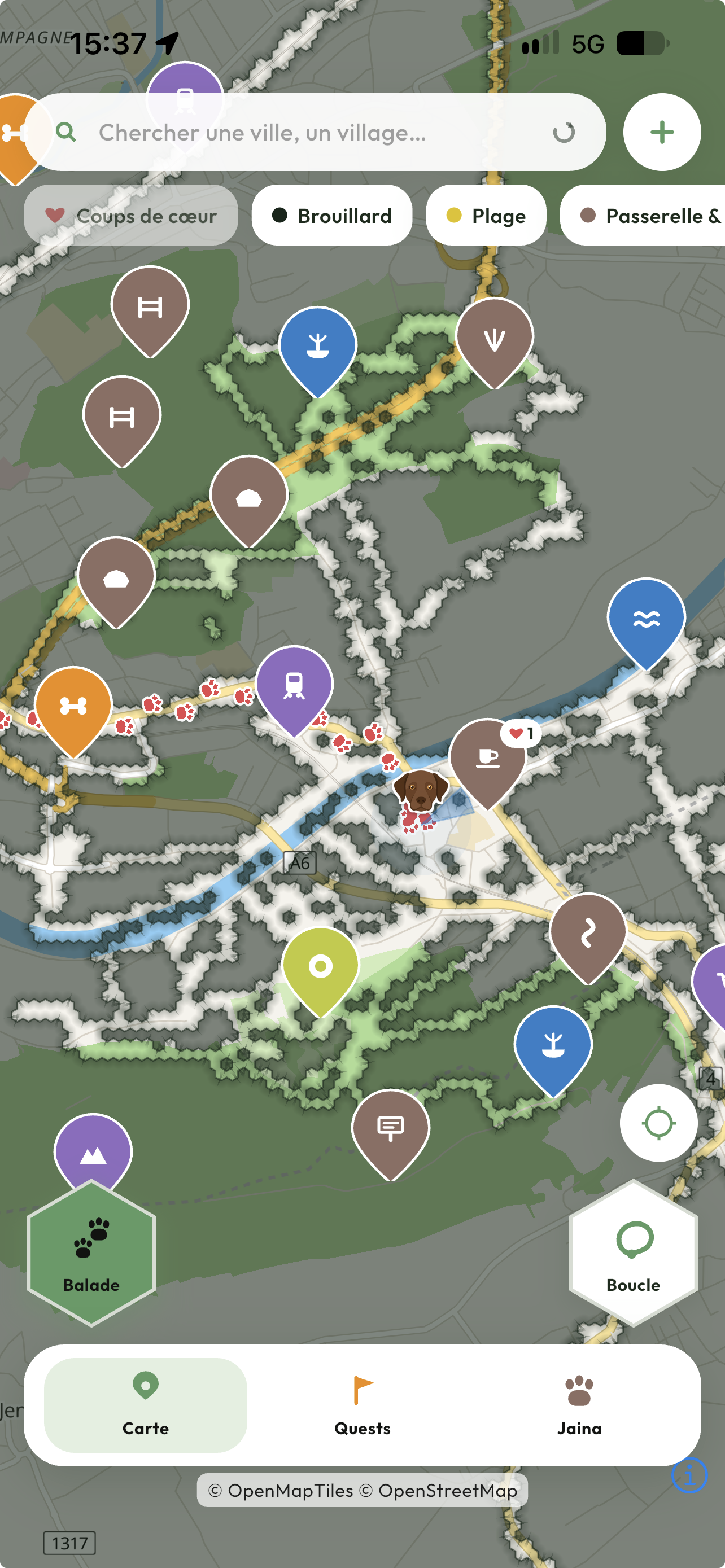
Quest.Dog isn't a training method. It helps with one specific but, in my view, essential part: doing varied things with your dog. Quests in town, outdoors, in the rain, in the snow, so what you teach them works everywhere, not just in your living room.
Quest.Dog is available on the App Store: search for "Quest.Dog".
FAQ
What's the best way to train a dog?
There's no single miracle method. The best is usually a serious trainer's complete approach, applied fully and consistently rather than in bits and pieces.
Why won't my dog listen even though I follow the method?
There can be many reasons: not enough activity, a new environment, stress, or small mistakes in how you do it. Rewatch the videos carefully, ideally as a pair, or ask for an outside eye.
Can I mix different dog training methods?
You can, but it's risky: each method has its own internal logic. Mixing them often loses that consistency and sends your dog mixed messages.