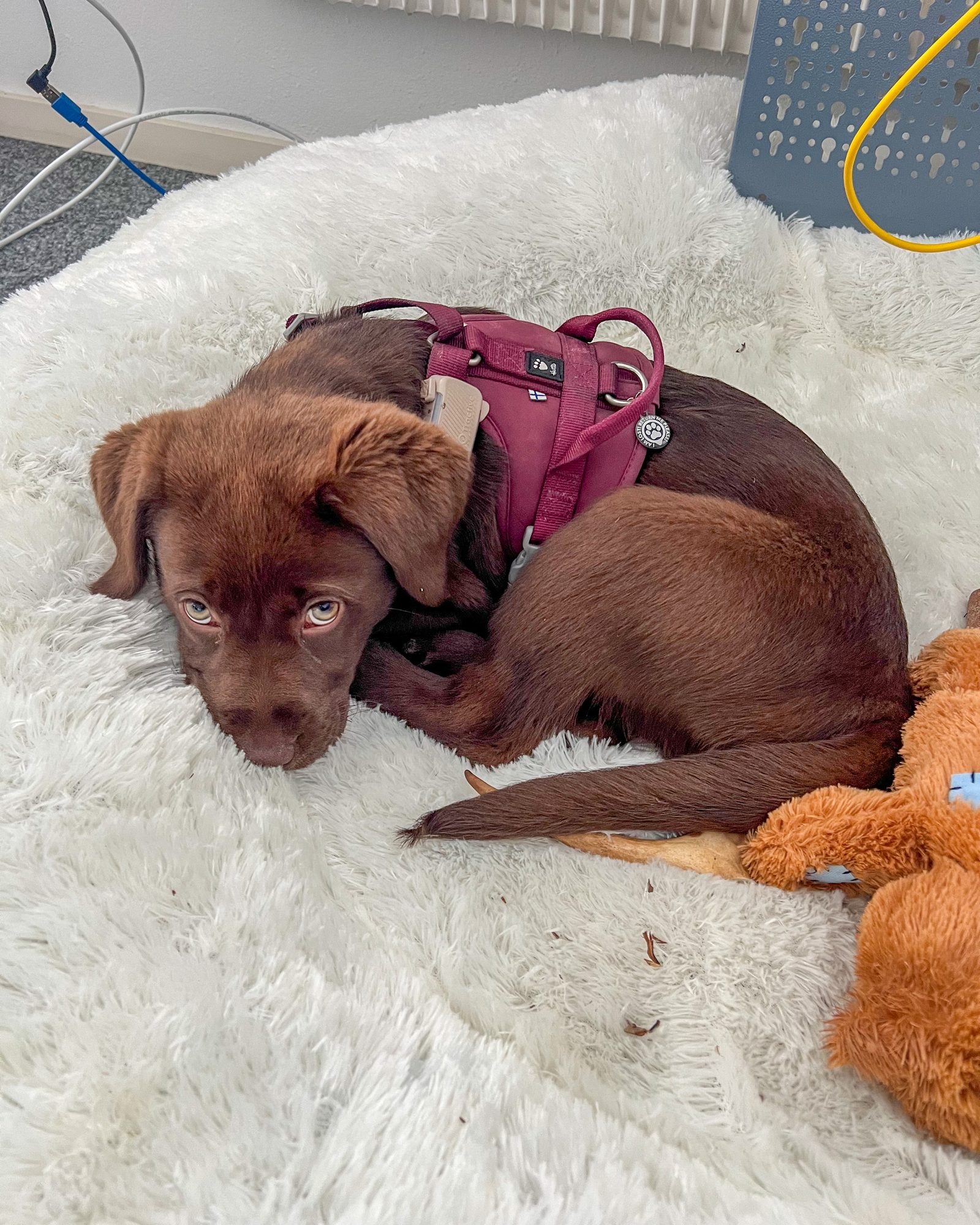
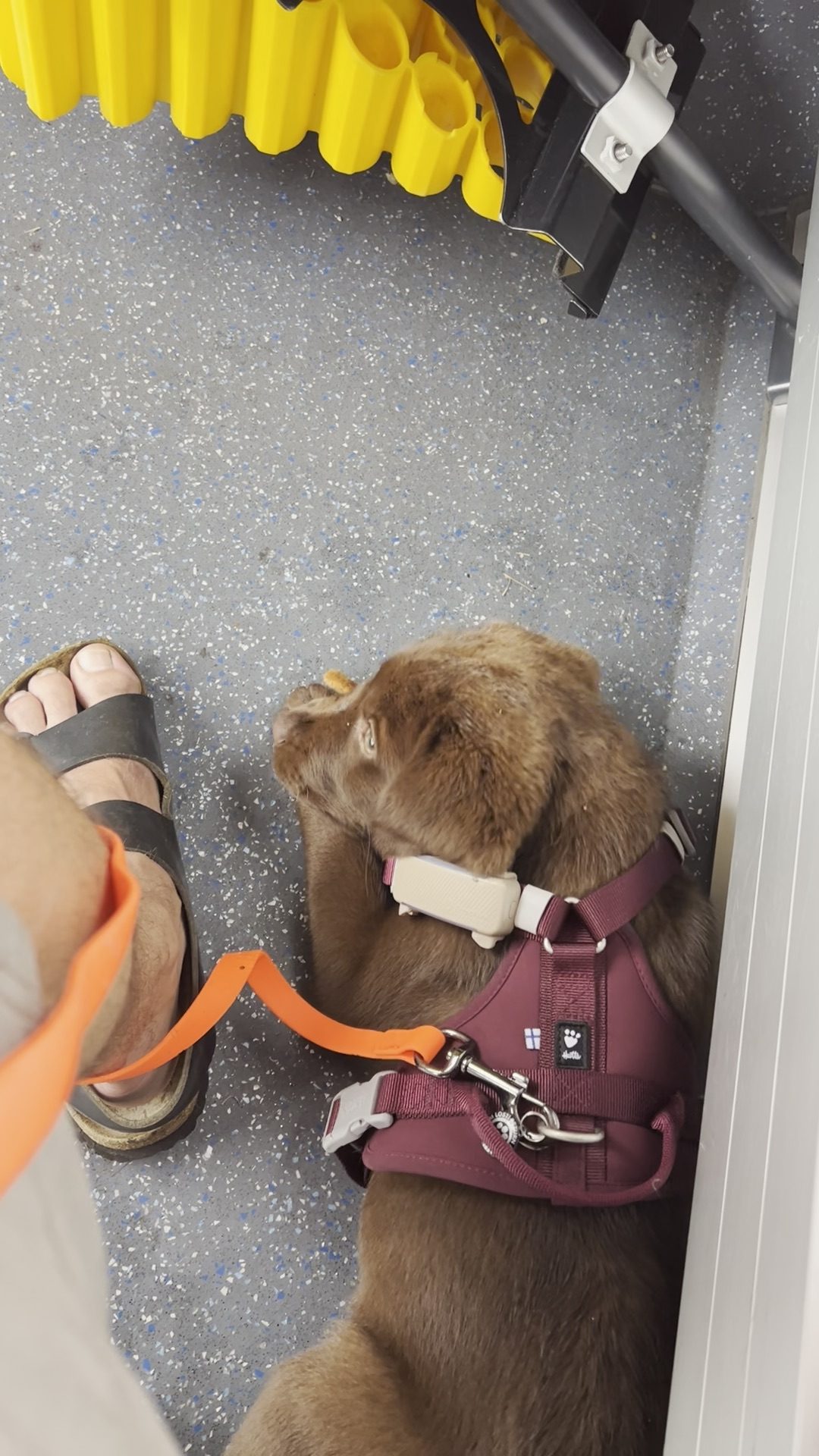
Taking your puppy on the train: my tips
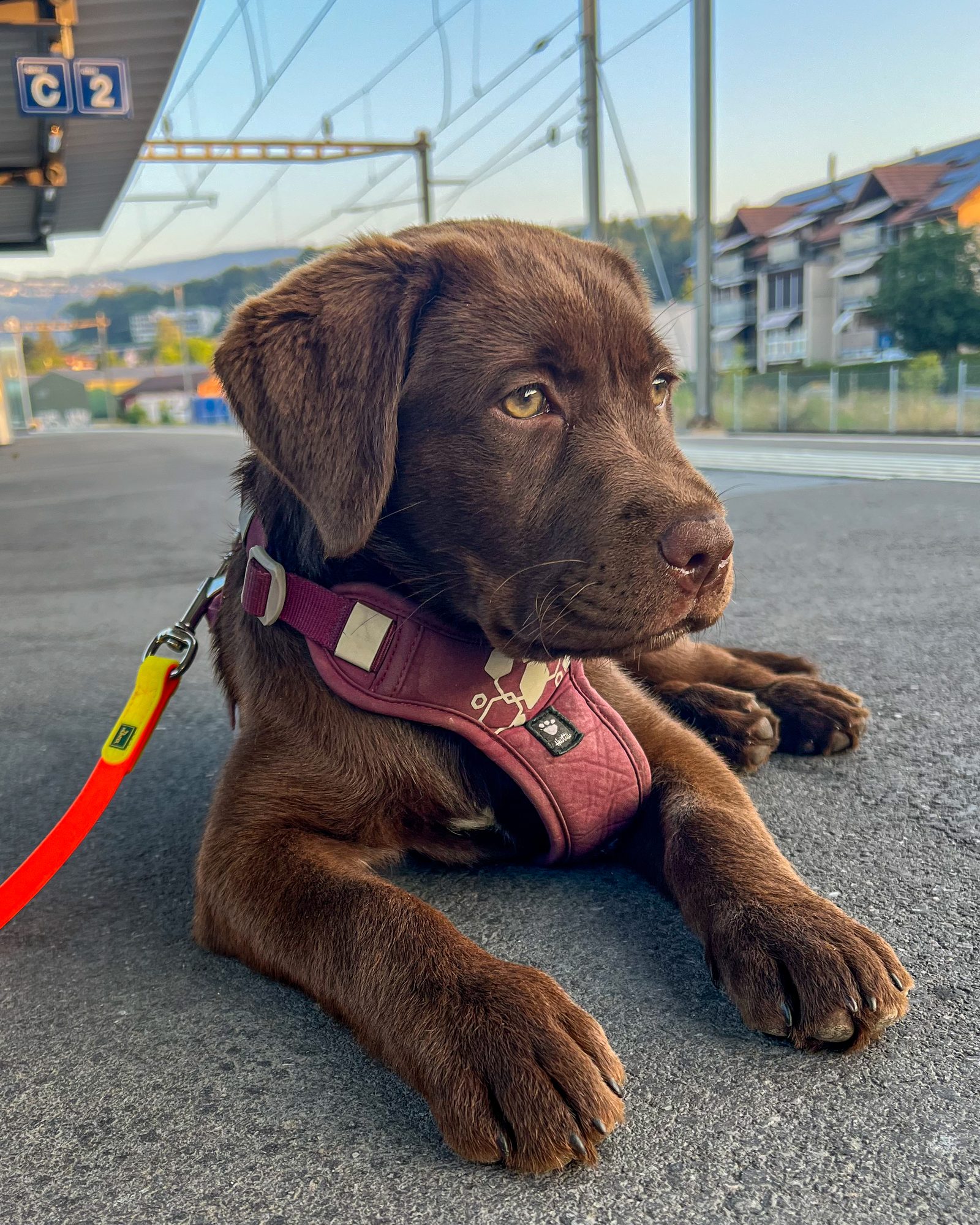
After the bus, it's the train's turn. A lot of the advice from my article on taking your dog on the bus applies here too, but trains come with their own challenges. And contrary to what you might think, the ride itself isn't the hardest part.
As usual, I'm neither a dog trainer nor a breeder. I'm just someone whose dog, Jaina, now takes the train almost every day at six months old. I'll simply explain how we did it.
The hardest part isn't the train, it's the station
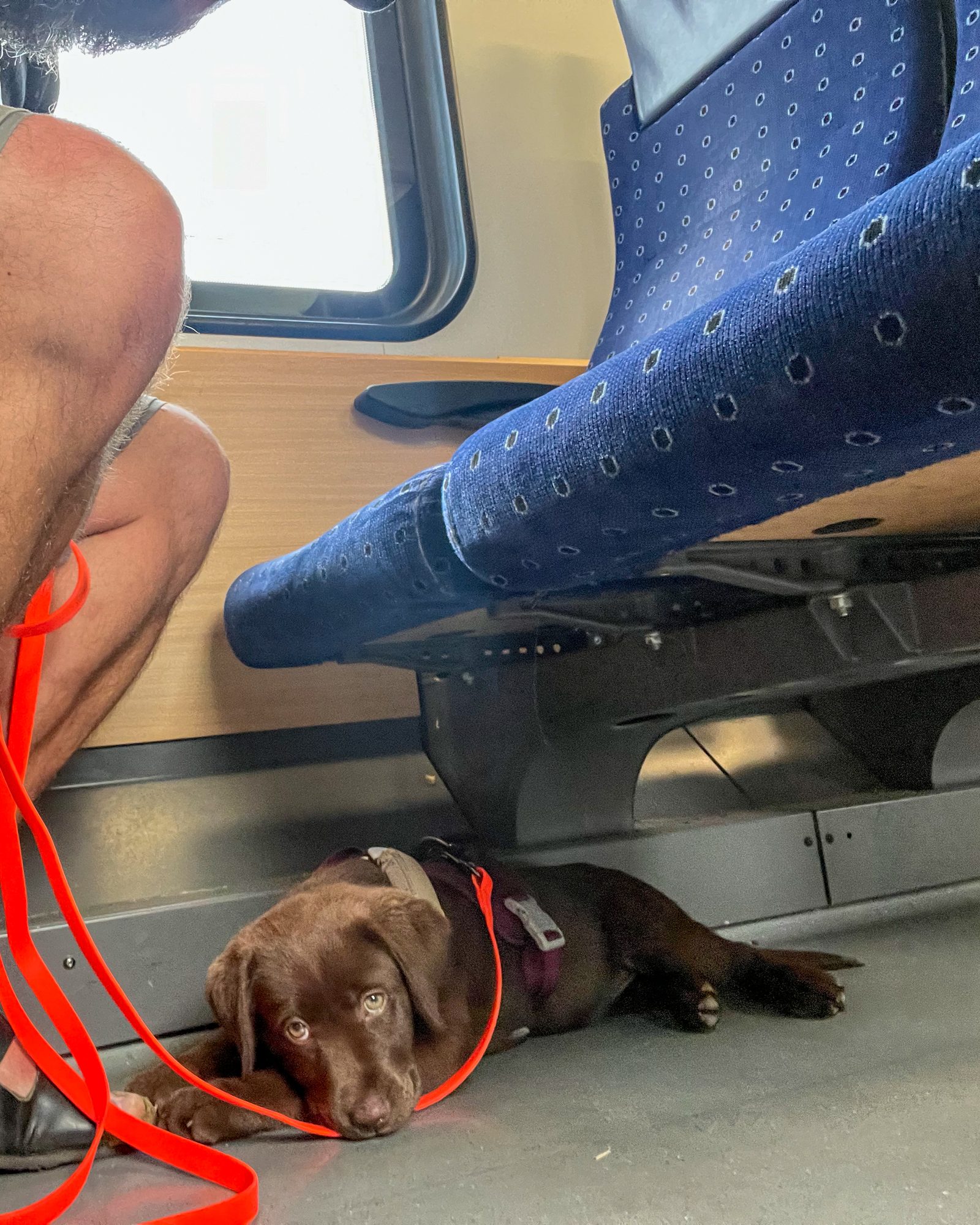
Ironically, once you're on board, the train is easier than the bus. A bus turns, brakes and accelerates: for a puppy who doesn't have much balance yet, that's harder. A train mostly runs in a straight line. You settle in and almost forget you're moving.
The real challenge is getting to the train: the journey to the station (on foot, by bus or by car), then the station itself. There are usually far more people than at a bus stop, plus other dogs, pigeons, food everywhere… For a puppy of eight to ten weeks, walking straight into a big station can be scary.
Prepare before your puppy even arrives
Ideally, get ready before your dog comes home:
- pick a station near you that you know is quiet;
- pick a quiet time of day, when you feel at ease;
- work out where to go and what to do: which platform, which entrance, where to board.
That way, on the day, you go straight to the right place at the right time, without stress. Let's be honest: with a baby dog, you're always a little stressed. You're afraid someone will step on them, that they'll run off, get into mischief, meet another dog… The less you have to figure out on the spot, the calmer you'll be. And so will your puppy.
Before boarding: a short walk
Just like with the bus, start with a dog who's already settled. Walk a little before reaching the station and let them do their business. It sounds silly, but a puppy who has already walked and had a pee is much calmer. And when they're small, you don't need half an hour: a few minutes is enough.
The real danger: the gap between platform and train
For me, this is the riskiest moment. Your puppy is small, isn't used to jumping and may be scared. And the train only stops for a few minutes, so there's no time for exercises on the platform.
Some trains aren't level with the platform: there are two or three steps, often steep and high for a baby dog. For the first few times:
- pick your puppy up;
- step into the carriage and find a spot with enough room;
- put them down calmly.
They'll already be getting used to being on the train. Later, when you can tell the steps are less of a struggle, let them climb on by themselves, gently.
My tip: a harness with a handle
We switched from a collar to a harness quite early. Most have a small handle on the back, and it's really handy: in front of steps going up or down, you simply support your puppy by the handle. They make the movement themselves, they're not scared, and you know they won't fall into the gap between the train and the platform. The result: at six months, they handle stairs with no fear.
If the station is overwhelming: carry them
The first real time Jaina took the train, she was ten or eleven weeks old. We spent fifty minutes on the train between our village and Bern, one of the biggest stations in Switzerland. I couldn't choose the time, so we arrived at rush hour with huge crowds.
Once again, your attitude is what matters. As dog trainers keep saying, including the French trainers at Esprit Dog, your dog watches how you react. If you're calm, they think: "OK, my human knows what they're doing, they know where we're going, everything's fine."
On the platform, we walked calmly. Then, inside the station, there were just too many people for such a small dog. So I picked her up, we walked out of the station calmly, and I put her back on her paws once things were quiet. From my arms, she could see the shops, the people and all the movement without being swamped by the crowd. And at that age she couldn't walk for hours anyway.
That's my strategy, and there are surely others. Good news, too: people find puppies adorable. Nobody bothers you, and owners of adult dogs usually keep their distance or ask if it's OK for their dog to say hello.
It was a bit stressful for me, but it went extremely well.
On the train: space, and watch those paws
These days, we commute to Bern together twice a week. Jaina is a Labrador, so she's growing fast: you need a spot where she has room to lie down. When she was little, and still now and then, I give her something to chew or a toy when it's busy.
One thing to watch, on buses too: make sure nobody steps on your dog. Jaina likes to watch what's happening in the aisle, so she sometimes pokes her head out. And as she's big, her tail sticks out past the seats. If someone treads on it, it hurts, and early on a bad experience can have consequences. Nothing dramatic, but you'd then have to slowly teach them again that everything is fine.
The train is part of a bigger picture
Trains, like buses, are places full of people. Unlike a walk in the rain, which you can do alone in the woods, everything comes together here. If your dog is scared of other dogs, the problem won't really be the station but the dogs they meet there. If they're scared of people, it'll be the crowd.
For me, training is a whole: the more things you do with your dog while they're young, the more normal everything will feel, and the more places you can take them. That's how I see life with Jaina: I want her with me almost all the time, living a good life, whether we're heading to the mountains or to work.
And even if you have a car, teach your dog the train. You never know: one day you might not have a car, or be able to use it. If your dog learned young, it should never be a problem again.
How Quest.Dog helps get your dog used to stations
In Quest.Dog, the app I built, the City family includes quests at train stations and bus stops near you. It's a great way to remember to go back regularly, even once your dog is no longer a puppy.
Quest.Dog is available on the App Store: search for "Quest.Dog". On Android, the app is still in beta. Leave your email on quest.dog to get access.
FAQ
At what age can you take a puppy on the train?
From the first few weeks, starting with a quiet small station and a short ride. Jaina made her first long trip at around ten or eleven weeks.
How do you get a puppy onto a train?
For the first few times, carry them over the steps and the gap between platform and train. After that, help them with the handle of a harness so they learn to climb on by themselves.
Where should your dog sit on the train?
Somewhere with enough room to lie down, away from the aisle so nobody steps on them. A chew toy helps them stay calm.
Are dogs allowed on trains?
It depends on the operator and the country: a ticket, a carrier for small dogs, a lead or a muzzle may be required. Check before your first trip.